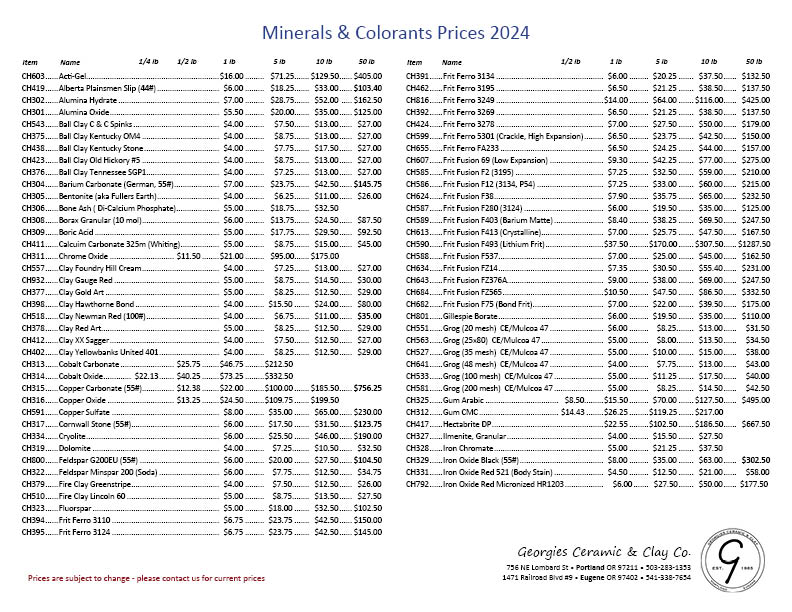
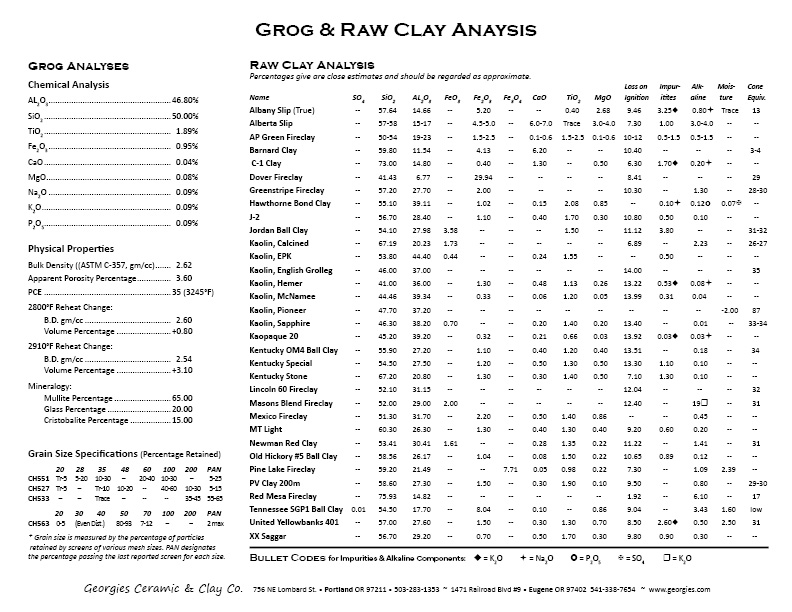
Georgies offers a wide variety of raw materials for clays, glazes and other uses. If you don't find the materials you need, please contact us. We may be able to get it for you OR suggest suitable replacements. The Occupational Health & Safety Administration devised this color-coded numerical ratings system to quickly and easily summarize the levels of risk through various means of exposure to potentially hazardous chemicals. Safety Data Sheets contain more detailed information about any risks posed by chemicals or raw materials, along with handling, cleanup and first aid instructions. Georgies maintains a library of SDS forms for the materials we sell. To request copies, please contact us by phone, fax or email.
| 0 - Skin |
| 1 - Inhalation |
| 0 - Ingestion |
|
CH411
Calcium Carbonate 325-mesh
WHITING: the main source of calcium oxide in glazes. High temperature flux giving durability and hardness to glazes. |
|
| 1 - Skin |
| 2 - Inhalation |
| 2 - Ingestion |
|
CH311
Chrome Oxide
A versatile coloring oxide used in glazes to produce various green tints. Produces blue-green hue when combined with cobalt oxide, or browns with zinc oxide. |
|
| 0 - Skin |
| 1 - Inhalation |
| 0 - Ingestion |
|
CH557
Clay Foundry Hill Cream |
|
| 0 - Skin |
| 1 - Inhalation |
| 0 - Ingestion |
|
CH932
Clay Gauge Red
|
|
| 0 - Skin |
| 1 - Inhalation |
| 0 - Ingestion |
|
CH377
Clay Gold Art
A very plastic air-floated secondary clay used in clay bodies where recipes call for ball clay or fireclay. Fires to light cream with approximate 7% shrinkage at cone 8. |
|
| 0 - Skin |
| 1 - Inhalation |
| 0 - Ingestion |
|
CH398
Clay Hawthorne Bond
A Missouri fireclay of good plasticity and fine particle size. Light fired color with approximate 10% shrinkage at cone 10. |
|
| 0 - Skin |
| 1 - Inhalation |
| 0 - Ingestion |
|
CH518
Clay Newman Red
Newman Red is a red-burning, low-plasticity fireclay with low dry strength. It's useful in plastic and casting bodies to impart red color and has powerful staining abilities. |
|
| 0 - Skin |
| 1 - Inhalation |
| 0 - Ingestion |
|
CH378
Clay Red Art
A high-iron secondary clay used in glazes and clay where low temperature clay is required. Fired red-brown with about 14% shrinkage at cone 1. |
|
| 0 - Skin |
| 1 - Inhalation |
| 0 - Ingestion |
|
CH412
Clay XX Sagger
A fine-grained secondary clay which fires to a light cream with 13% shrinkage at cone 10. Considered very effective in salt firing, and it's claimed that it works well in wood firing too. |
|
| 0 - Skin |
| 1 - Inhalation |
| 0 - Ingestion |
|
CH402
Clay Yellowbanks United 401 |
|
| 0 - Skin |
| 1 - Inhalation |
| 0 - Ingestion |
|
CH313
Cobalt Carbonate
Used as a glaze colorant and for decoration. Dry powder color is pink, but produces blues under all conditions. Not quite as concentrated as cobalt oxide, gives softer blues. Finer particle size avoids speckling. |
|
| 0 - Skin |
| 1 - Inhalation |
| 0 - Ingestion |
|
CH314
Cobalt Oxide
Produces consistent strong blue tones. Slightly larger particle size compared to cobalt carbonate, which can induce speckling in glazes. |
|
| 1 - Skin |
| 2 - Inhalation |
| 2 - Ingestion |
|
CH315
Copper Carbonate
A green and turquoise colorant in oxidation. Can produce blue-greens and copper reds in reduction atmospheres. |
|
| 1 - Skin |
| 2 - Inhalation |
| 2 - Ingestion |
|
CH316
Copper Oxide
Copper oxide is one of the oldest glaze colorants. A strong flux, producing fluid glasses. Doesn't change under normal oxidizing conditions, but may produce copper reds in reduction. Preferred for many uses. |
|
| 1 - Skin |
| 2 - Inhalation |
| 2 - Ingestion |
|
CH591
Copper Sulfate |
|
| 0 - Skin |
| 2 - Inhalation |
| 2 - Ingestion |
|
CH317
Cornwall Stone
Cornish Stone is a type of spar used in clay bodies, giving strength while firing. Also used in engobes for its adhesive power during and after firing. Used in glazes for its low shrinkage and minimal defects. |
|
| 1 - Skin |
| 2 - Inhalation |
| 2 - Ingestion |
|
CH334
Cryolite (Kryolith)
Sodium aluminum fluoride can be used as a source of insoluble soda flux, but fluoride may bubble through glazes, causing pinholing. May be used in small percentages as a flux in low-temperature clay bodies. Gives off poisonous fluoride gas during firing. |
|


 Portland Follow Us! Eugene