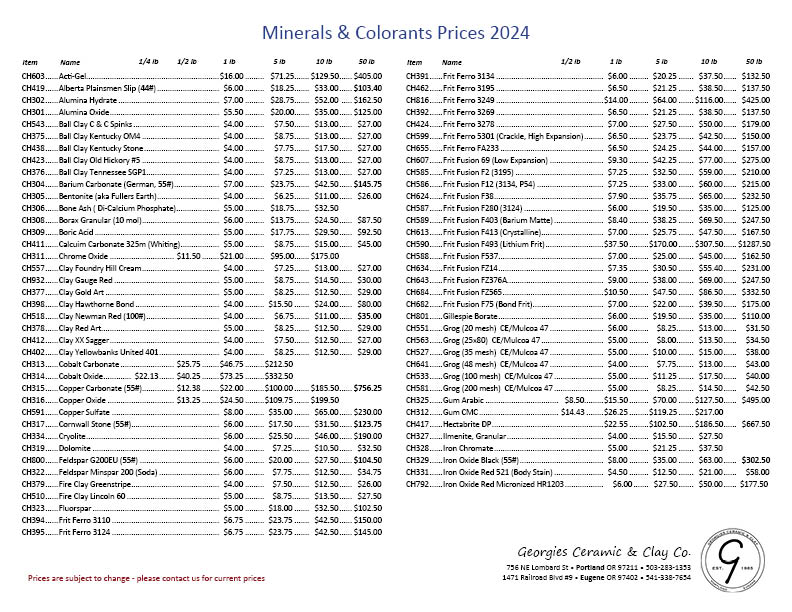
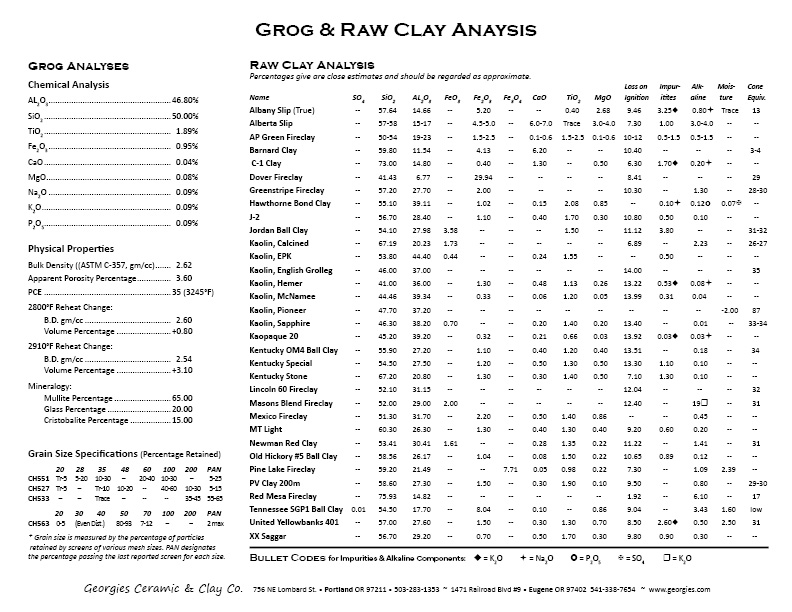
Georgies offers a wide variety of raw materials for clays, glazes and other uses. If you don't find the materials you need, please contact us. We may be able to get it for you OR suggest suitable replacements. The Occupational Health & Safety Administration devised this color-coded numerical ratings system to quickly and easily summarize the levels of risk through various means of exposure to potentially hazardous chemicals. Safety Data Sheets contain more detailed information about any risks posed by chemicals or raw materials, along with handling, cleanup and first aid instructions. Georgies maintains a library of SDS forms for the materials we sell. To request copies, please contact us by phone, fax or email.
| 0 - Skin |
| 1 - Inhalation |
| 0 - Ingestion |
|
CH543
Ball Clay C&C Spinks |
|
| 0 - Skin |
| 1 - Inhalation |
| 0 - Ingestion |
|
CH375
Ball Clay Kentucky OM4
A fine-grained ball clay with excellent plasticity and strength. OM4 is an industry standard based on its popularity in both casting and plastic formed bodies. It is also widely used as a suspension aid in glazes. |
|
| 0 - Skin |
| 1 - Inhalation |
| 0 - Ingestion |
|
CH438
Ball Clay Kentucky Stone
A coarse-grained, siliceous ball clay known for its high strength and plasticity. Applications include artware and ceramic tile. May be substituted where Gold Art or Ball Clays are called for in recipes. Fires to light cream with about 11% shrinkage at cone 10. |
|
| 0 - Skin |
| 1 - Inhalation |
| 0 - Ingestion |
|
CH423
Ball Clay Old Hickory #5
A popular secondary clay used in both clay and glaze formulas. Very plastic, fires to a light grey with about 13% shrinkage at cone 10. |
|
| 0 - Skin |
| 1 - Inhalation |
| 0 - Ingestion |
|
CH376
Ball Clay Tennessee SGP1
A coarse-grained, fast-casting ball clay used in all types of casting applications. |
|
| 2 - Skin |
| 3 - Inhalation |
| 3 - Ingestion |
|
CH304
Barium Carbonate
The main source of barium oxide in glazes. Used as a flux and assists in formation of matte finishes and in neutralizing sulfates in clay bodies. Insoluble in water. Added to clay bodies in small amounts to prevent some sulfide discoloration. |
|
| 0 - Skin |
| 2 - Inhalation |
| 1 - Ingestion |
|
CH305
Bentonite
A very plastic magnesium clay containing colloidal matter, which lends plasticity to a clay body. Not used alone because of high shrinkage, stickiness and swelling tendencies. |
|
| 1 - Skin |
| 1 - Inhalation |
| 1 - Ingestion |
|
CH306
Bone Ash (Dicalcium Phosphate)
Dicalcium phosphate is a very important calcium and phosphate source. When added to a clay body like bone china, bone ash adds translucency and lowers the maturing temperature. Also gives a textured finish in lowfire glazes and opacity in highfire glazes. |
|
| 0 - Skin |
| 1 - Inhalation |
| 1 - Ingestion |
|
CH308
Borax Granular (10 mol)
A soluble low-temperature flux, lowers the fusion points of glaze and promotes smooth melting. Produces bright colors with oxides. A source of sodium and boric oxide in glazes. |
|
| 0 - Skin |
| 1 - Inhalation |
| 1 - Ingestion |
|
CH309
Boric Acid
Used as a flux, increasing gloss and elasticity of glaze. Improves fit between glaze and clay body. Tends to be water-soluble. |
|


 Portland Follow Us! Eugene